
Like a Nomad

We all need someone in our life who can shock us into a new way of thinking. That person for me is my youngest child.

He has always demonstrated a level of understanding the world in ways that seem to surpass my own. His even temper and clear headedness is enviable.

We had the need to take an overnight trip to do some work where our RV camper is this weekend. As we were loading up to come back home, he said to me, “you need to learn to pack more like a nomad!”

Well, what on earth did that mean? I got that he was frustrated by the volume of stuff we had to come back with. It was one 24- hour period after all. How much could we possibly need?

Apparently, in my mind, we needed all our juices and freezer items so we could eat “our food.” And extra linens in case I didn’t already have what we needed there. (There was PLENTY there, by the way.) And, well, all my toiletries even though the camper bathroom is so tiny, your knees jam up against the tub from the toilet and there’s room enough on the counter for a toothbrush or two and a bar of soap. And the cabinet is about an inch deep.

I knew that I was taking too much from home to make the trip “more bearable” for me, but I didn’t really think about it the way he does.

What’s the opposite of “like a nomad?” I asked him. We talked through it and landed on “like a colonizer.” He didn’t love that word but it struck me. And it struck me because it spoke to my need to make another place as much like MY home place as possible. And it seared through me because that position removes our openness to experiencing another place – or person – as it is, (or as they are.)

It reminded me of how much I despise the White Savior mentality of “doing missions” in the form I was exposed to in my youth – bringing salvation to a people group as if our culture was what would save them. It reeked of Christian Nationalism but it took years before I could step far enough back to see how unlike Christ our efforts were in that context.

So, next time I’m packing for a destination, I’ll remember the lesson in packing “like a nomad.” I do want to be willing to experience other places and other people authentically without comparing against my place or my ways of doing things. It’s in those times of temporary discomfort that we grow and can humbly recognize our place in the world and our connection to others who share it.
The Shoes

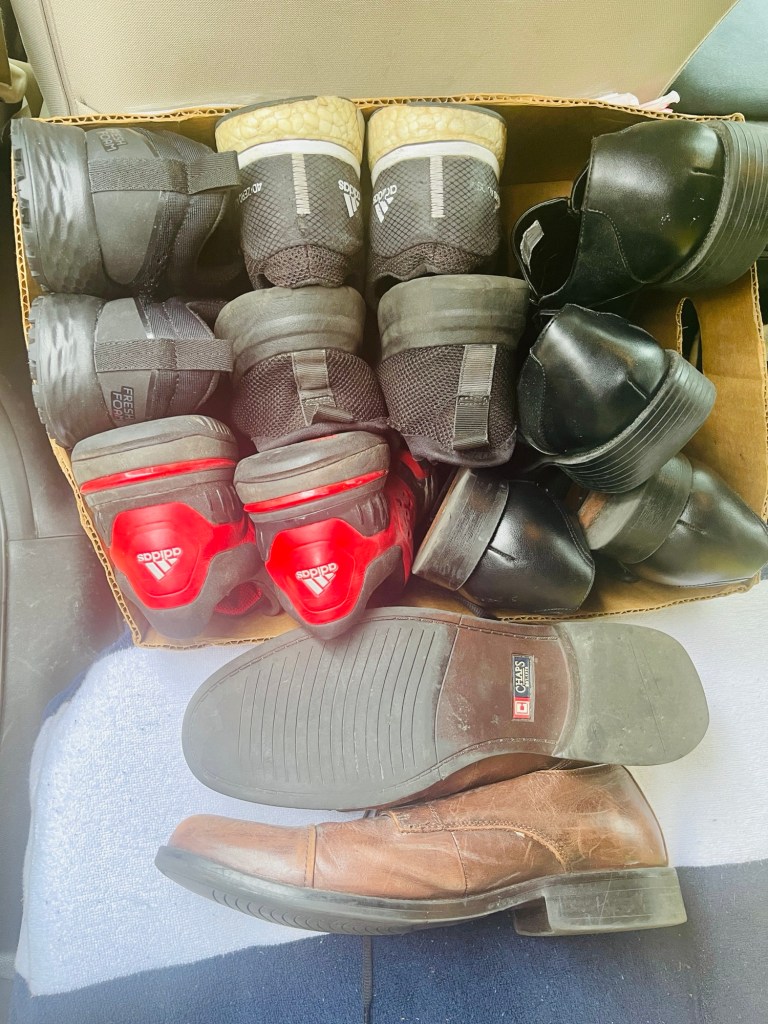
Today, I’ve packed up Joshie’s shoes – 7 pairs of them that have been upstairs at my house the past 7 years. After much turmoil and peacemaking, I’m putting them into the hands, or onto the feet, of other people.

He was a shoe lover, not unlike me. These were under no circumstances all of his shoes – just the ones at my house. If I may speak woo-woo language to you, I have heard their cries to release them into the world. And so today, they are released.

The thing that has to happen when you lose one so precious is an ongoing reconciliation with what’s left here. Everything – really, everything – takes on a level of importance that didn’t exist before. For that reason, any movement or removal of things can become rather ceremonious.

I’ve donated many, many things multiple times over the decades. Never before has it brought me to tears. Not for the loss of things, mind you, but for the absence of the one to whom they belonged. And for all the ways my own growth and movement through time on this earth requires such adjustments within and around me.

As for the shoes, may the one who needs them be drawn to them and may they imprint the earth once again, exchanging the energy of love and mercy, hope and joy with each step.

Hard to live with

My youngest child is like so many others in that he speaks, unfiltered, whatever is on his mind. “Why do you have to be so hard to live with?!” he cried after I issued his punishment for the crime of disobedience. What he did wasn’t terrible – he simply chose not to listen to me until he was ready – and his punishment wasn’t earth-shattering, either. (Although, to a 6-year-old boy, losing a few hours of Wii is close to earth-shattering.) The point of my response wasn’t the level of severity of his bad behavior and the point of his response wasn’t the severity of the assigned punishment. It was the principle of the thing – on both counts. I insist on respectful obedience from my children and he persists in trying to do things his own way and in his own time, regardless of what I say. So, who’s harder to live with? I dealt with it by laughing. You know, that “Silly boy, it isn’t ME who is being difficult, but your own choices that are creating difficulty for you” laugh; the “You’re the one being stubborn, not me” laugh.

This may be easier to resolve in parent-child relationships since there is a power differential. But what about stalemates like this in adult relationships? Are there times when we are less-than-gracious when we should offer someone the opportunity to express their individuality? Well, of course.

I am not a big fan of campaign season in the political realm. I dislike the negative ads and the boasting ads equally. If there was a party called Humble Integrity, I’d probably join that one. As it stands, there isn’t one remotely close to that. [Ok, I came up with the cool acronym: Humble Integrity Party = HIP!] As a HIP candidate, I would do all my campaigning via Facebook, Twitter, and blogging. Oh wait – maybe that is how I would do it as a member of the DLCP (Don’t Like Crowds Party). . . Let’s face it. I’d never be a suitable candidate for political office.

Not too many of us risk having our lives dissected, chewed up, and spit out in the national forum. Our family has a way, though, of exposing to us the things we either deny or would otherwise like to keep under wraps about ourselves. Marriage is the great revealer of life areas in need of personal growth. Our level of stubbornness is revealed in how we respond to the knowledge that we need to grow enough in an area to demonstrate grace. If we can humbly apologize and seek to let go of our personal agenda (which is often linked to nothing vital), then we become much more pleasant to be around. If we disregard the revelation and dig in our heels to ensure no one “runs over us”, then we might be setting ourselves up for a lot of head-butting.

So, with that in mind, and to avoid running the risk of being known as a head-butt-er (or any variation of such), let us be mindful of the grace that is ours through Jesus. I would rather be known as someone who is hard to live without than hard to live with.