The Positioning

If you’re an intuitive person at all, you know what a “gut feeling” means. It is a deep uneasiness. It is a gnawing knowing that something unpleasant is about to happen.


It’s what I was feeling back in September as I saw and heard signs that my employer was having serious issues related to their profitability and positioning. I knew because I was part of the executive team. Still, I was shocked to learn that my name was on the list of people whose positions would be eliminated as part of a RIF (reduction in force) layoff.


While I had only been with that team 2-1/2 years, it was still a gut punch. What I remember most was something I said the day the CEO told me my position was ending – much sooner than what had been described as a possibility at year-end. I said, “well, I guess now I get to experience a layoff!”


That response reflects the deepest mind and thoughts of someone who has faced and survived so. many. losses. And traumas.


This event adds to a long list of perils including: myriad abusive narcissist + empath relationships, divorce, death by suicide of my first-born … and now this. For the first time ever in my employment history, I would lose my main source of income – while my child is at university 3 states away.

In perspective and comparison to some of the more life-threatening things I’ve endured, this is a small thing. However, it stings and it hits all my triggers. My 23-year-old self who came back to NC with a suitcase full of ruined clothes and nothing else to her name, covered in bruises and pregnant was somehow resurrected in this moment. All her fears and feelings of being unsafe, unprotected, and unsupported were screaming in the background.

Meanwhile, my current self has plenty of resources and support. I have had to console the younger version of myself over and over and over again during this time, reminding her that everything is ok now. It is ok and it will be ok. We aren’t starting from nothing anymore.

I’m still sorting out my next steps and have begun to “position” myself and my career differently. Rather than applying for work as an employee, I am offering my services to clients who need administrative support on a fractional basis. This seems wise to me.

During the course of all this positioning and healing, and reassuring, I painted on top of a piece of art that hung on my wall. I recreated it into a textured, semi-3D scene I titled “Storm Watch.” It represents the feeling, the stinging, the blowing … and the beauty and the power and the hope that will now define this period of my life.

With gratitude, I will, once again, emerge from this injury as a reimagined and repositioned version of myself – more whole, more grateful, more tried and tested, and closer to the woman God created me to be.
Joy from the Mothervine

Plants haven’t always been a source of joy for me, but this is increasingly the case. My joke has always been that I only do well with plants that “thrive on neglect.” In this phase of my life when my old excuses about being busy raising kids no longer hold water, I aim to be more intentional in nurturing and caring for my plants.

Last summer, on the final day of our 10-week summer market marathon at The Shamrock, I had a strong and undeniable pull to stop at our family cemetery before starting my 2 hour trek west to my house. It wasn’t normal. The inner call was loud and persistent. I passed the turn, too tired and too hot to add a stop, but that very loud insistence caused me to turn around and go directly to the cemetery.

This cemetery, named Sahara, is the burial site for my oldest son and both parents. Other beloved cousins are there, too. I don’t avoid going, per se, but when I go, it is sacred. This was the first time I was so persistently called there. So I gave this visit my undivided attention.

After spending time at each burial location, offering my undying love for the souls whose lives are marked in remembrance there, I looked across to where my paternal family’s grapevine once thrived. I had been told it was no longer there but as I walked closer I saw it had grapes – and lots of them! Giddy with excitement evoked by childhood memories of that vine in its prime, I started to gorge myself (as one does) on the scuppernong delicacy it had once again produced. While enjoying them, my mission revealed itself. “Don’t throw the seeds down. Take them. All of them.”

And that is precisely what I did. I wrapped all the seeds carefully in a paper napkin and returned to my car to head west. (After realizing several ticks had also tried to hitch a ride and frantically removing them from my legs and clothing.)

It took a while for me to do anything with the seeds after bringing them home. But, when the right situation presented itself, things came together quickly. My oldest grandson, whose dad is buried at Sahara, was very interested in growing particular plants at that time. He was incredibly meticulous and researched his favored ones. I told him about the seeds and invited him to help me plant them all in some soil. So, with great care and intention, we planted all the seeds.

And those pots sat on my porch for months. I watered the dirt occasionally but didn’t see any signs of life. Until about a week ago.

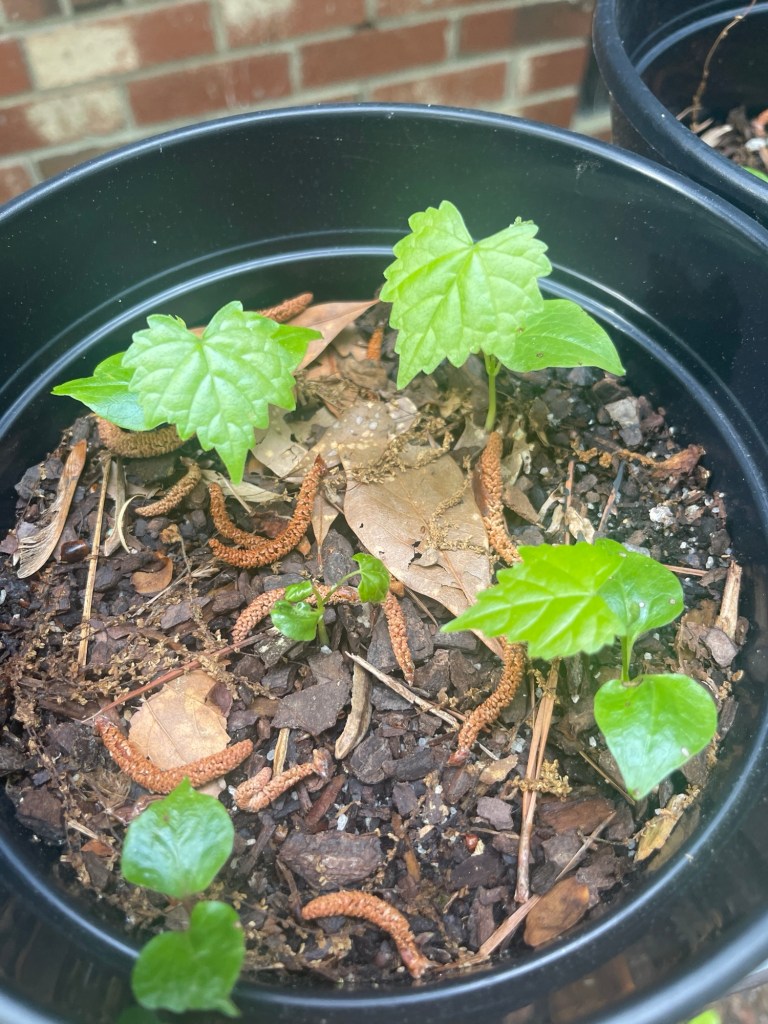
Grape babies

And suddenly, there they were! All of my nurturing instincts are now engaged and I have a tremendous sense of responsibility for these wee grapevines! I feel a sense of calling to bring them into their fruition.

And I’m grateful (grapeful?) they chose me as their partner.

Seeing and saying what God is doing

The way we experience events and circumstances in our lives has everything to do with the perspective from which we look. We can think of that perspective as our personal operating system if you like computer language.  When we are faced with circumstances that are difficult to comprehend, we can easily fill in the empty spaces of our understanding with stories we tell ourselves that are simply not true. And the danger of believing false assumptions is that we not only tell these stories to ourselves – we might share them with others. It’s a shortcut in our operating system that causes us to believe the story we manufactured to fill the empty, unknowing spaces.

In John 20:1-18, we read the gospel writer’s telling of Resurrection morning. From our reading, we know what Mary’s purpose was on the early morning that she arrived at the tomb of Jesus. She was coming to care for his dead body by anointing it with spices – something that couldn’t be done over the Sabbath.

Mary’s intention was an act of deep love. We can imagine that Mary was in a very difficult frame of mind when she arrived at the location of Jesus’ tomb early that morning. Remember, she saw Jesus die on the cross. She remained after others had left. She knew the dangerous situation she and the other disciples were in as followers of Jesus. So that morning, when she saw the stone was removed, she responded by making assumptions that were, frankly, very understandable given the circumstances. She assumed Jesus’ body had been taken. She had obviously already imagined that possibility and it was something she feared. So, she ran with it. Literally. She told herself a story of what PEOPLE were doing and then she took THAT story to the disciples. They have taken the Lord out of the tomb and we do not know where they have laid him. Mary saw Jesus’ absence in the tomb as the work of MEN. She couldn’t see. Not yet.

We all approach our trauma in different ways. And we all carry beliefs that limit our ability to perceive what God is doing when God is doing a new thing. When our limiting beliefs about what *can* happen are challenged, it takes a while for us to believe what we are really experiencing or seeing.

Mary, already broken by the death of Jesus, told herself a story about his missing body that morning that she believed to be true: someone took the body of Jesus away and she didn’t know where they put him. She just wanted to know where he was so she could go tend to his body. Her love compelled her to honor him that way. That’s why she remained in despair as she heard the voice of the man she assumed to be the gardener outside of the tomb. “Woman, why are you weeping?” It was the same question the angels asked her. “They have taken away my Lord and I do not know where they have laid him.” This version of the story tormented her. Immediately Jesus asked, “Whom are you looking for?” Mary replied, “Sir, if you have carried him away, tell me where you have laid him, and I will take him away.” 

And then it happened.

That’s when Mary’s ears heard the voice of Jesus, calling her by name. “Mary!” “Rabbouni!” she responded, recognizing the voice of her beloved teacher and friend and Lord. Her tears of despair and grief were instantly turned to tears of elation and joy! This was the moment when Mary’s vision turned from what she believed people were doing to seeing what God had done and what God was doing! The one who died was now alive and standing in front of Mary.

The scripture tells us that Mary, the first person to share the good news of Christ’s resurrection, said these words as her testimony to the other disciples: “I have seen the Lord!” Friends, our testimony about Jesus’ resurrection is an ongoing story that begins with “I have seen the Lord.” Sometimes, those words are enough. Sometimes we might also say what we have seen the Lord do. But when we say we have seen the Lord – we have seen Jesus – we have seen the risen Christ – we are still testifying to the resurrection.

What is your story that begins with “I have seen the Lord!”? I encourage you in these days of trauma – threats of war, economic unrest, threats and acts of violence, injustices and abuses of power – to look for what God is doing. Don’t frame the stories you tell yourself and others by what you see other people doing.

See and say what God is doing.

Look for what God is doing.

Participate in what God is doing.

Align yourself with what God is doing.

God is doing a mighty thing – even and probably most importantly in the days when darkness seems to have overcome us – God is at work in the world for good! From that place of seeking God, you too will testify as Mary did. Let these words move you from tears of sadness and worry to tears of elation and joy: I have seen the Lord!

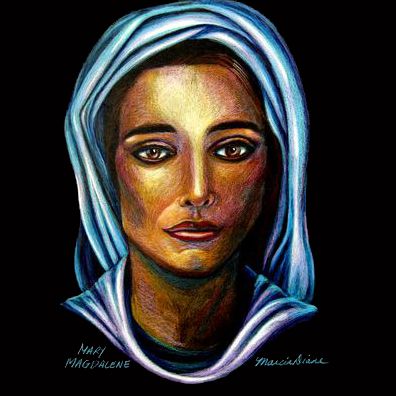
Mary Magdalene by Marcia Diane. http://www.marciadiane.net

Like a Nomad

We all need someone in our life who can shock us into a new way of thinking. That person for me is my youngest child.

He has always demonstrated a level of understanding the world in ways that seem to surpass my own. His even temper and clear headedness is enviable.

We had the need to take an overnight trip to do some work where our RV camper is this weekend. As we were loading up to come back home, he said to me, “you need to learn to pack more like a nomad!”

Well, what on earth did that mean? I got that he was frustrated by the volume of stuff we had to come back with. It was one 24- hour period after all. How much could we possibly need?

Apparently, in my mind, we needed all our juices and freezer items so we could eat “our food.” And extra linens in case I didn’t already have what we needed there. (There was PLENTY there, by the way.) And, well, all my toiletries even though the camper bathroom is so tiny, your knees jam up against the tub from the toilet and there’s room enough on the counter for a toothbrush or two and a bar of soap. And the cabinet is about an inch deep.

I knew that I was taking too much from home to make the trip “more bearable” for me, but I didn’t really think about it the way he does.

What’s the opposite of “like a nomad?” I asked him. We talked through it and landed on “like a colonizer.” He didn’t love that word but it struck me. And it struck me because it spoke to my need to make another place as much like MY home place as possible. And it seared through me because that position removes our openness to experiencing another place – or person – as it is, (or as they are.)

It reminded me of how much I despise the White Savior mentality of “doing missions” in the form I was exposed to in my youth – bringing salvation to a people group as if our culture was what would save them. It reeked of Christian Nationalism but it took years before I could step far enough back to see how unlike Christ our efforts were in that context.

So, next time I’m packing for a destination, I’ll remember the lesson in packing “like a nomad.” I do want to be willing to experience other places and other people authentically without comparing against my place or my ways of doing things. It’s in those times of temporary discomfort that we grow and can humbly recognize our place in the world and our connection to others who share it.

The Shoes

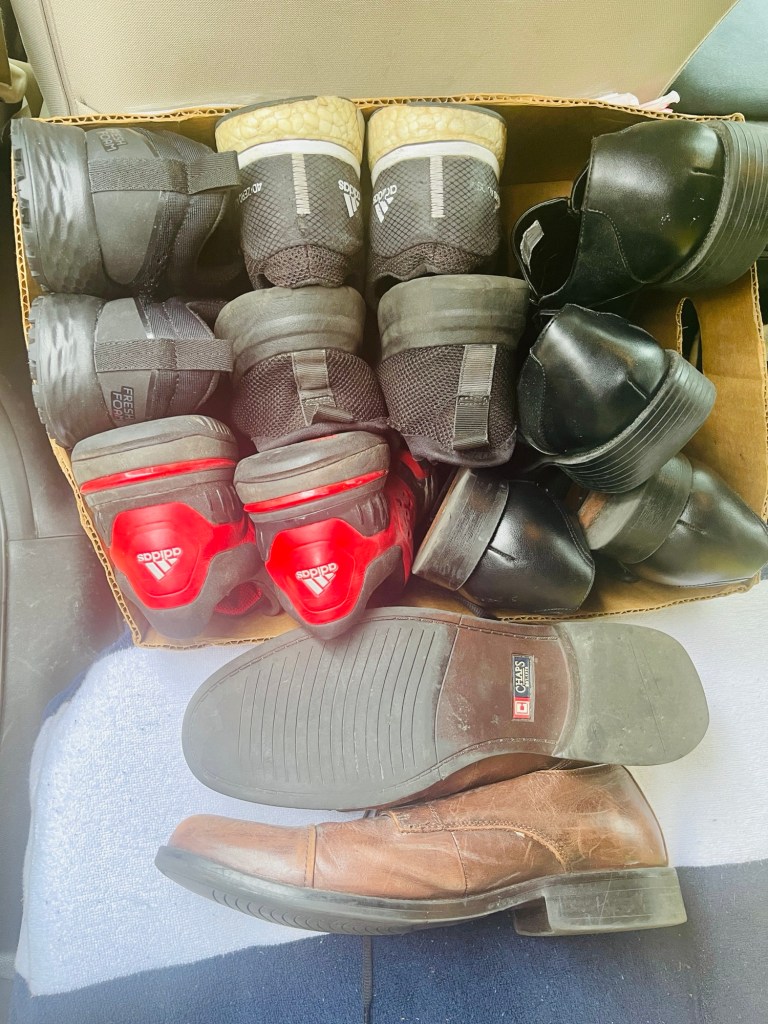
Today, I’ve packed up Joshie’s shoes – 7 pairs of them that have been upstairs at my house the past 7 years. After much turmoil and peacemaking, I’m putting them into the hands, or onto the feet, of other people.

He was a shoe lover, not unlike me. These were under no circumstances all of his shoes – just the ones at my house. If I may speak woo-woo language to you, I have heard their cries to release them into the world. And so today, they are released.

The thing that has to happen when you lose one so precious is an ongoing reconciliation with what’s left here. Everything – really, everything – takes on a level of importance that didn’t exist before. For that reason, any movement or removal of things can become rather ceremonious.

I’ve donated many, many things multiple times over the decades. Never before has it brought me to tears. Not for the loss of things, mind you, but for the absence of the one to whom they belonged. And for all the ways my own growth and movement through time on this earth requires such adjustments within and around me.

As for the shoes, may the one who needs them be drawn to them and may they imprint the earth once again, exchanging the energy of love and mercy, hope and joy with each step.

Flying and crying

My TikTok feed is filling up with empty nesters seeking to share and find consolation as their last child in the home strikes off as a young adult, usually off to college. This didn’t happen accidentally of course – it’s very timely for me since my youngest is navigating the age of 18 as a senior in high school. Somehow, the algorithm knew.

He’s having a great time experiencing successes in school while juggling having a girlfriend, a job, and a (premature) sense of being grown. He has big plans and big talents to match, so I sincerely expect great things ahead for him. He can hardly wait to get at it ALL.

Meanwhile, I am losing it.

Nothing makes sense, and yet, everything is going as it should. He is stretching in ways that make me literally insane, and he is becoming independent and (very slowly) responsible. He needs me for little other than a place to sleep and consume snacks and utilities. And I’ve raised my children to be independent and socially responsible adults, so that’s good, right? I have been preparing myself mentally for his “leaving the nest” to happen in 2024. Not 2023. But he is rarely here and, when he is, he isn’t really interested in being parented.

But, that’s who I am. I’m a parent. A doting mother. And I’ve been a sole parent for the huge majority of my parenting life. I’ve been raising one child or another since 1989 – and most of that time, in the same house. So, this is my current crisis. I know I have to rediscover my authentic self and nurture her and live life like a grown woman should – that’s precisely how I would advise anyone who might come to me in the same predicament. But, right now, I just feel broken. And alone. And used up. I can’t formulate any plans for myself. I vacillate from wanting to go on a worldwide spiritually contemplative tour to merely contemplating whether I can muster the energy to go to Wegman’s. I don’t want to do either of those things alone. I just don’t.

I also don’t want to go chasing new people. Sincerely do not want. But, this is where I can begin to spiral – in the toilet swirl of everything I don’t want. So, my question to myself is, “what do I want?”

And that question sends me waaaaay back to my 17-year-old self when I had to choose an academic major. I can see myself seated at a table in an exercise of crossing off everything I knew I didn’t want to do on the list of majors and related careers. Then, I see and hear my mother telling my then-boyfriend, “she doesn’t know what she wants.” Well? What do I want for myself in this one big life?

A Grammy. I want that.

A man who is safe and creative and emotionally intelligent and loving and responsible and wise in Christ as my companion and partner. I want that. If not all those things, I’d rather be on my own.

A published book (or a few.) I want that, too. This is probably the easiest one to wrap up.

In a nutshell, I want to expand my legacy for my children and grandchildren and live this phase of life with a partner I can trust and continue to grow with. I want to see new people, places, and things in the world and build new things in my own part of the world. I. want. to. enjoy. life.

But, first, I have to find the motivation to get off the sofa, put on regular pants and shoes, brush my hair, and drive to the grocery store. Today, that’s my struggle.

Photo credit: Locean Studio | London Lanier Photography

A rainy day reflection

We’ve all seen it. When an unexpected (or even an expected) rain shows up in the middle of an active day, people respond in comical ways to the prospect of being negatively impacted by getting wet. It’s an interesting thing to observe, not because of the face value cause-effect, but because of all the little things that lie beneath the surface. It can be stress inducing. But it doesn’t have to be.

Basically, it seems we can correlate our tolerance for getting wet in the rain with our determination or ambition to accomplish things regardless of circumstances. This correlation is not static by any means. There are days when we are more willing than others to endure the discomfort and changes to our physical appearance that result from getting wet. I’m just saying, our reaction to rain reflects so many things going on inside us.

I remember a time when my youngest was a preschooler and we had to go to Target on a rainy day. (This may have been more of a stormy day than just a rainy day.) I had one umbrella and hands full — handbag, shopping bags, and my little boy who held my hand as we ran to and from the store. When it was said and done, his pants and shoes were soaked. “How on earth did you get so wet?” I asked, implying that he should have been drier since we were both under the umbrella. “The rain has a little helper, Mom,” he said, “and its name is wind.”

Indeed, it does.

Recently at work, I was having a conversation about our human nature in reaction to doing difficult or uncomfortable things, particularly doing those things over a sustained period of time. Our purpose was to figure out ways to coach our team through an intense growth spurt. In that conversation, I used the image of a sudden downburst of rain to describe our general resistance to that sort of discomfort and change in circumstances. Most of us do not want to get wet. And we avoid it for myriad reasons, not the least of which is the way it changes our appearance – picture the “drowned rat” we refer to so often. We are far more willing to endure the inconveniences and discomfort of an absolute soaking when we have significant incentives that override the negative feelings about getting wet.

Soaked!

Today, my son and I were downtown having lunch together when the bottom fell out of the sky. The rain wasn’t just heavy, it was torrential. We had no particular reason to hurry and nowhere in particular to go afterward, so we weren’t stressed. And we didn’t have umbrellas. As we left the restaurant to head over to a nearby coffee shop, we passed several folks huddled in the foyer of the restaurant, waiting for the rain to pass. And, on the street, there were various mixtures of folks with umbrellas, makeshift umbrellas, and nothing (like us) to limit our getting wet. While in the coffee shop, it occurred to me that getting wet in the rain is a purely physical experience – a sign of life, if you will – with mental and emotional implications. In other words, the way we perceive getting wet unexpectedly in the rain drives our experience of it entirely. And we can change our perception of things.

The Birth of a Tradition

Christmas is a time of year chock full of traditions. It may hold some of the only traditions I follow, actually. I’ve even built my own family tradition of Special Day during the Christmas season – a day spent doing fun things with each of my kids as my gift to them. Special Day and Christmas Eve worship service are my hardcore traditions.

This year, it seems that a new tradition was born. It wasn’t planned. An invitation was made and it was accepted by a community of people dear to me. The invitation was radically simple: will you join me in decorating a really big tree that sits on a busy highway? Let’s add lights that offer hope and joy to passers-by; ornaments to honor loved ones.

And boy, did they accept! The tree that sits on property that belonged to my grandparents, then to my parents, now belongs to me. I had a dream that prompted me to seek owning it. That dream continues to develop – seeds of renewal and growth for a community I love.

I don’t present myself as a sad or grieving person. I do, however, carry a deep and abiding pain related to the death of my firstborn son nearly 5 years ago. Life, for me, splits into two segments: before Josh died and after Josh died.

What I learned in making an offer to use this tree to remember loved ones is that 1) there are many, many people who feel the sting of loss during Christmas in my small hometown, and 2) there’s something very healing in coming together to remember our beloveds who are no longer with us. And a Christmas tree is apparently a GREAT place to bring all these emotions and people together!

As we celebrated Christmas huddled as a group in the dark around our adopted tree, all of us who placed ornaments in honor or memory of a loved one felt a special presence this year. We heard his or her name spoken. We saw their light shine. We sang carols together. We felt sad together and we felt joy together. That is the definition of love and the definition of community.

And, before we parted ways, we agreed to do it again next year. That big but ordinary tree is now a symbol of love, joy, community, and Christmas spirit – <snap!> just like that!

It isn’t you, it’s your ego

Very often, the first thing you see in a situation doesn’t define it well. You think you’re dealing with a certain issue, but the real issue is hiding behind the one that shows up first. Maybe several layers behind.

Current example, I have found myself bucking hard against opinions over the last several weeks and months – unsolicited, random opinions in particular. I have become more and more outspoken about my notion that opinions are the lowest form of human communication. Opinions are like body odor to me: we all have them and we should avoid airing them onto others.

Why such contempt for opinions? Well, I thought it’s because I see opinions as nothing more than preferences. Your preference isn’t right or wrong. It’s just a preference. My preference isn’t right or wrong, either. It’s just another opinion. Weighing and reacting to opinions is a royal waste of time. I am highly protective of my life energy, so I avoid spending any mental or physical energy on futile exercises. I recommend the same for you.

But that’s not the whole story either. I’ll dive a LOT deeper than that, so come with me if you can handle it. I say that because getting to the deeper issue will get too personal and likely uncomfortable. It’s actually not personal opinions that I dislike reacting or responding to. It’s the ego hiding behind it. It’s the egocentric expectation that an opinion should somehow change what the recipient thinks, says, or does. It’s the egocentrism that is unable to acknowledge that there are myriad opinions and preferences and there isn’t one correct one. It’s the self-centered attempt to rid the world of anything one person doesn’t like or prefer or appreciate – at least the small sliver of the world that person occupies.

In Christian teaching, the ego is our enemy. The ego represents the false-face we develop and present to the world – our avatar, if you will. Following Jesus *requires* a complete turning away from the self-serving ego in order to follow the way of Love. Where ego seeks to satisfy itself and to defend itself and to grow itself in the view of others, humility seeks the exact opposite. We cannot feed our ego and our faith at the same time. We cannot follow our ego and Christ-in-us at the same time.

So, it’s not your opinion I’m bucking. It’s your ego.

If egocentric opinions are unwanted and unhelpful, then what does a humble opinion look like and is it more desirable? It looks more like constructive feedback. It considers the whole group, not just one person’s preference. It is offered only when requested for the purpose of growth, not thrown out unsolicited like a belch to relieve one’s personal need to release noxious gas. Constructive feedback is just that: constructive. It builds others. It builds communities. Humility is necessary in any community context because humility embraces its own transformation while the ego desperately resists it.

One's Ego Can Only Aggravate This Crisis - La Prensa Latina Media

christianespanosa.com

Speculation and anxiety

I’m an anxious person. It’s odd that my demeanor is typically that of a calming presence because underneath that smooth facade is some serious duck-paddling.

I struggle with what you’d call high functioning anxiety. It isn’t debilitating – it is, however, exhausting. At my worst, I avoid thought-provoking down time by busying myself to heroic levels. At my best, I exercise or take naps. In all cases, my anxiety feeds on the aloneness I find myself in during this single/COVID time in life. When I’m alone, my thoughts lead me to unanswerable questions.

It seems to me, as I listen to every American anchorperson on TV tonight discuss the outcome of today’s election in speculative terms, that speculation is the root of worry and anxiety. When we can’t know something, we fill in the gaps with speculation. We tell ourselves stories based on speculation – many of which are absolutely untrue – and we believe those lies we’ve developed.

If you’ve practiced this form of self-torture for any length of time, then you know how hard it is to undo. At the same time, once you learn to recognize the destructive pattern, you begin to see it more and more, making it possible to undo.

Anxiety has been and continues to be fed during this season of elections-wrapped-in-a-pandemic. Folks who aren’t typically bothered by anxiety are affected. Folks who suffer with it are manifesting some of their worst symptoms. So, how do we manage?

For me, it begins with making peace with the unknowable. Do I still imagine the worst case scenario? Absolutely – it’s how I’m wired. Rather than holding my scenarios as prophetic truth, though, I look at them as manifestations of my anxious worrying. I can set them aside. (I actually imagine the quantum theory range of possibilities and realize how arrogant it is to believe in my ability to accurately predict future outcomes. Please.)

Even more broadly, I believe in a loving and faithful God. I have questioned how to reconcile that love with some of the dreadful ways I’ve suffered in this life. But, when I remember the darkest times, I also remember being most certain of God’s love and presence when life was most uncertain. Awareness of the presence of God in Christ has been the hallmark of the most un-anxious times in my life.

As events unfold, I encourage you to see speculation for what it is and not to seize any of it as truth or fully predictive of outcomes. Feed what is good; talk about what is hopeful; live in a way that enacts love. Love wins while speculation predicts loss.